-
Biography

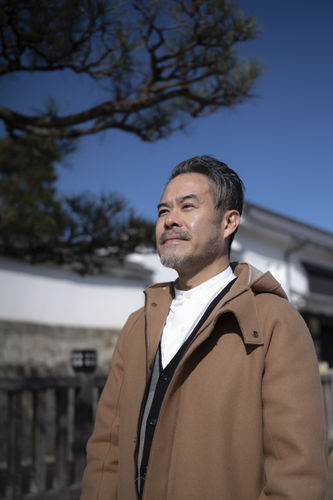
Nihonga style painter Daisuke Nakano (b. 1974) paints with an animated expression that imbue his images with a lively energy. He is precise, visionary, and patient. Each line is perfectly calculated to capture perpetual movement; he depicts a sense of time standing still. Nakano explores the unique sense of two-dimensional space particular to Japanese Nihonga painting. Nakano is inspired to use gold or silver leaf as a base—a method developed by Ito Jakuchu of the Rinpa School during the Edo period (1615–1868). Evanescence and sorrow take center stage in Nakano's depictions of nature's overwhelming power and the climax of life: flowers in full bloom will eventually fall and return to the earth. It is the intoxicating paradox of life which Daisuke Nakano realizes in vivid and sublime color.
Biography
Graduated from Doda Bijutsu Kogei High School. At the young age of 19, Daisuke exhibited his artwork at the group exhibition.
2019 Solo exhibition, "Burst of Nature" (Ippodo Gallery New York, USA)
Exhibition at Saga Arashiyama Museum of Arts and Culture (Kyoto, Japan)
2020 Exhibition, A Brush With Beauty at the Indianapolis Museum of Art at Newfields (USA)
2021 Solo exhibition, "Painting Radiance" (Ippodo Gallery New York, USA)
2026 Solo exhibition, "Banquet of Life: Nihonga Paintings by Daisuke Nakano" (Ippodo Gallery New York, USA)
Public Collection:
Indianapolis Museum of Art at Newfields (USA)
-
Contributing Essay

Nemoto's Kana Choreography
— Sadako Ohki, September 2026
Former Japan Foundation Associate Curator of Japanese ArtYale UniversityLEAVES OF WORDS at Ippodo Gallery New York presents the contemporary Japanese kana calligraphy of Dr. Satoshi Nemoto. Nemoto’s highly refined practice begins with the careful selection of his materials - from Ganpi washi paper and treated paper with botanical dyeing (Kusaki-zome) to selected brushes crafted using techniques revived from the courtly Heian period (794-1185). The exhibition focuses on the dynamic, interwoven calligraphic style of Nemoto’s oeuvre, which incorporates his own poetry and short literary phrases drawn from his deep scholarship in Chinese and Japanese language, classical literature, and philosophy.
Three works selected here give us a glimpse of Nemoto’s uniqueness in the traditional field of Japanese kana calligraphy. Kana, roughly equivalent to the English alphabet, has origins in the 5th century, when Japan was faced with the need to make their own written language, abbreviating and adapting Chinese characters, kanji. Today, the Japanese language is a mixture of kanji and kana. In the field of calligraphic art, complicated use of multiple kana representations and styles heighten the aesthetic appreciation of kana calligraphy.
All selected three calligraphic works are based on a single waka poem of 31 syllables composed by the calligrapher Nemoto himself. The poem says:
“The color of the flowers blooming,
Woven in threads of rain
Words that spin and gather
a heart dyed in their hue.”
雨糸に 織られて咲いた 花の色 染まる心を 紡ぐ言の葉
amaito ni/ orare te saita/ hana no iro/ somaru kokoro wo/ tsumugu koto no ha
The poem suggests the blossoming of love, comparing it to a heart “woven in threads of rain” and dyed in the hues of blooming flowers.
The selected three works correspond to the Gallery Program List #2 Flow "Wisteria Trellis" (Fujidana), "「 藤棚」”; #7 Flow "Budding" (Hōga), "「 萌芽」",; and #8 Flow "Willow Waves" (Ryūrō), "「柳浪」".
Nemoto brushed Flow "Wisteria Trellis" (Fujidana), "「 藤棚」” on Echizen washi paper made in Fukui prefecture. He repeated the poetic lines of his waka in his mind while he made the general design of the piece. The design of the descending left half is brushed in an orderly manner while the right side expresses irregularity in the length of the columns and the spatial arrangements of the characters. Nemoto explained that he first brushed the kana in light ink. He then viewed the piece from different angles, applying varieties of kana forms in a darker ink, creating irregular formations that adds power to the work. The finished work looks like a flock of birds about to
take flight.
Flow "Budding" (Hōga), "「 萌芽」", witnesses the artist’s first experiment in applying a white pigment called gofun in place of black ink–traditionally made of ground sea shells mixed with glue–on a dyed sheet of paper. Applying gofun makes the paper less absorbent than ordinary washi. Thus, the gofun does not sink as deeply into the paper, leaving behind pools of white and dense marks. The artist revealed that he had a strong urge to draw from the lower to the upper sections of the page; however, it was impossible because brush lines are always painted from top to bottom. The tension beckons us into a wondrous adventure in a dark forest.
The calligraphic lines of Flow "Willow Waves" (Ryūrō), "「柳浪」" recall the long and sinewy branches of a willow tree blowing in the wind. Nemoto has included liquid spatters of white gofun on his work, enhancing the image of a strong wind blowing against the page. The piece evokes the imagery captured in Nemoto’s waka, suggesting the woven threads of love have begun swaying and taking flight after having gone through heavy entanglements in the forest.
The contemporary calligrapher Nemoto has opened up a new possibility in the modern art of kana. Rather than drawing a clearly singled out form of kana, he orchestrates them to become a linear symphony. He himself is the composer, the musician, and the conductor, using the fluent and abbreviated forms of kana in his artistic endeavour to touch our hearts.
How fortunate to have kana calligraphy that can represent a vital identity of unique Japanese written form! Creation of kana went through a messy process of conjuring through chaotic learning, adaptation, and abbreviation. We should not forget that women were at the forefront of simplifying the kana forms in early history. And today the calligrapher Mr. Nemoto uplifted the kana to be a pattern of melodical traces.
-
Works
Daisuke Nakano Japan, b. 1974
Deer, 2010Mineral pigments on paperH64 x W38 ¼ in,
H162.1 x W97 cmA19066Courtesy of Ippodo GalleryDaisuke Nakano’s 2010 painting, Deer, illustrates a herd of deer in action. The directional movement present in this painting is fantastic. The soft, chalk-like qualities of the paint on the canvas makes the deer’s movement quick and dream-like. The soft glow of the sunrise in the horizon, shining on the snow in the foreground, can almost be felt through the canvas as if the sun is radiating from the painting and into the space of the audience.
Provenance
Artist StudioExhibitions
Burst of Nature: Nihonga Paintings by Daisuke Nakano, Ippodo Gallery, New York, March 7 - April 6, 2019.PaintingVideoExhibitions-
Banquet of Life: Nihonga Paintings by Daisuke Nakano
19 Mar - 18 Apr 2026Exhibition opens Thursday, March 19th, 2026 coinciding with Asia week new yorkRead more
Opening Reception at 35 N Moore Street, TriBeCa: March 19, 2026, 6–8 PM
Private viewing by appointment only.
NEW YORK, NY – Ippodo Gallery is pleased to present Banquet of Life: Nihonga Paintings by Daisuke Nakano, the solo exhibition of acclaimed Japanese Nihonga painter Daisuke Nakano at Ippodo Gallery in TriBeCa, New York. Latest paintings featuring traditionally depicted scenes of flora and fauna are on view from March 19 to April 18, 2026. Nakano's much-anticipated return to New York coincides with Asia Week 2026; the artist joins us in New York from his native Japan for an opening reception on March 19. -
Light and Abundance: Gold in Japanese Art
13 Mar - 17 Apr 2025Exhibition opens Thursday, March 13, 2025 35 N Moore Street, TriBeCa New York, NY — GRAND OPENING Ippodo Gallery invites you to join our inaugural opening of the new downtown...Read more -
Painting Radiance
Light and Nature in the Art of Daisuke Nakano 25 Mar - 23 Apr 2021If There is a Heaven Daisuke Nakano creates paintings of light. I think, if heaven exists, it would resemble the landscapes of Nakano’s creation. Following Illuminating All Over the World,...Read more -
Burst of Nature
Nihonga paintings by Daisuke Nakano 7 Mar - 6 Apr 2019Burst of Nature Shoko Aono A nandina plant with red berries struggles under the weight of the falling snow while a marten holds its breath, its eyes gazing in our...Read more


Join the Ippodo Gallery newsletter
* denotes required fields
We will process the personal data you have supplied to communicate with you in accordance with our Privacy Policy. You can unsubscribe or change your preferences at any time by clicking the link in our emails.